Lab Tests Order Online: $14 vs $312 (Same Quest Lab)
▶ Watch the full breakdown
I walk through the exact lab markers to check, what each test really costs, and how to order it yourself — no doctor visit needed. Press play.
Prefer YouTube? Watch & subscribe on the Skip The Doctor channel.
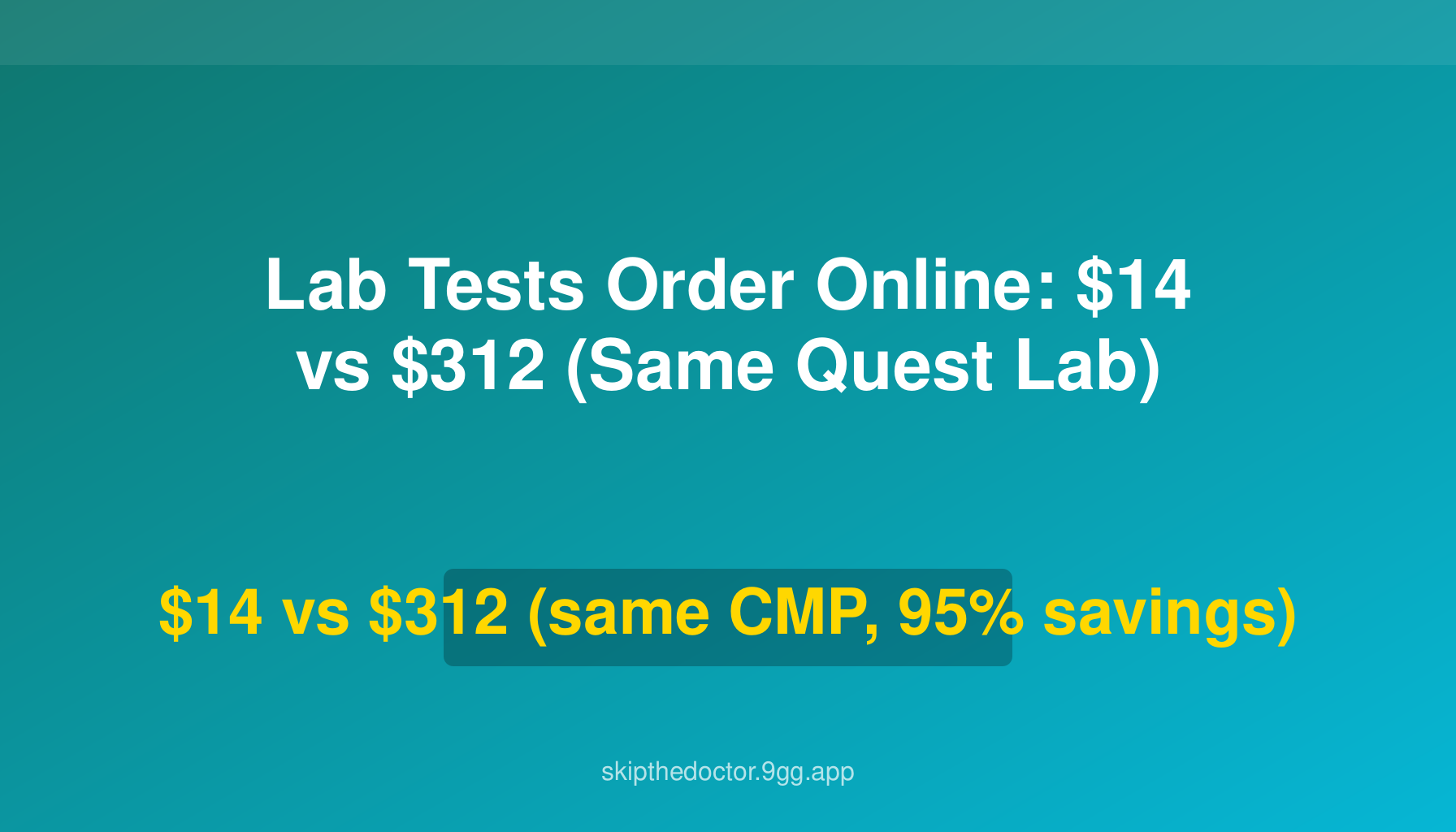
A standard comprehensive metabolic panel costs $14 at HealthLabs and $312 at a typical urgent care clinic. Same Quest Diagnostics blood draw. Same CLIA-certified lab. Same result PDF. The only difference is the middleman markup. If you want the test for the actual price, you can get this test at HealthLabs and skip the $200-300 doctor markup — you walk into the same Quest or LabCorp draw station with an order already in your inbox.
The model is simple. HealthLabs (and competitors like Walk-In Lab and Ulta Lab Tests) are direct-to-consumer ordering platforms that contract with Quest Diagnostics and LabCorp at wholesale rates. You pay them, they fax the requisition, you show up, you get drawn, and the result lands in your portal 24-72 hours later. No appointment. No copay. No facility fee. No specimen-handling surcharge. According to MedlinePlus, the test methodologies (immunoassay, mass spectrometry, and so on) are identical regardless of who ordered the test — what matters for accuracy is the lab's CLIA certification, not the requisition source.
Why the same blood draw costs 10x more at the doctor's office
The price gap isn't the lab doing something different. It's three middlemen layered on top when your physician orders the test: the office visit ($150-300), the venipuncture fee ($25-80), and a test-interpretation charge that often gets billed under E/M coding ($50-150). Quest and LabCorp's wholesale price for a complete blood count is roughly $3-7. Your insurance EOB might show $187 "negotiated" with $35 "patient responsibility" — and you'll feel like you got a deal. You didn't.
Cleveland Clinic's published self-pay price list shows a TSH (thyroid screen) at $89 cash. HealthLabs lists the same TSH at $39. The Mayo Clinic Laboratories reference wholesale rate is closer to $12. The chain of markup is real, and it's why hospital outpatient lab departments are one of the highest-margin lines in American healthcare. A 2024 RAND analysis of commercial claims data found outpatient lab pricing variability of 8-15x across the same metro market for identical CPT codes — the widest of any service category they tracked.
The 7 most-ordered tests and what they actually cost online
These are the most commonly self-ordered panels, with realistic 2026 direct-to-consumer cash prices versus typical in-network "patient responsibility" after a doctor visit:
| Test | Online cash | Doctor-route bill |
|---|---|---|
| Complete Blood Count (CBC) | $14 | $95-220 |
| Comprehensive Metabolic Panel (CMP) | $14 | $110-312 |
| Lipid Panel (cholesterol) | $19 | $120-280 |
| TSH (thyroid) | $39 | $89-240 |
| Hemoglobin A1c | $29 | $95-180 |
| Vitamin D, 25-Hydroxy | $45 | $210-450 |
| Full STD panel (8 markers) | $148 | $650-1,400 |
For a yearly "executive physical" style workup — CBC, CMP, lipid, A1c, TSH, Vitamin D, ferritin — the direct route runs about $175. The same bundle through a primary care visit plus the lab order routinely tops $900 after the visit charge and lab markups. The NIH notes that annual screening of these baseline markers is appropriate for most adults over 35, which is a lot of money to leave on the table every year.
What markers make sense to track yourself
Educational framing, not medical advice: any marker you'd review at a routine annual visit is a reasonable self-ordering candidate. The NIH and CDC both publish reference ranges for the baseline panels above, and the result PDF you receive includes the lab's reference flags (H/L) — so out-of-range values are obvious at a glance. Most people use direct-to-consumer testing for the same reason they use a home blood pressure cuff: tracking a trend over time without paying for office visits to watch numbers move two points.
Where the doctor route still matters: anything that triggers a downstream clinical decision. Suspicious symptoms, abnormal results that need a follow-up workup, anything requiring imaging, biopsy, prescription, or a specialist referral. A confirmed-elevated A1c needs a primary care plan. A flagged PSA needs urology. The test is cheap; the interpretation and treatment pathway is what your clinician's training is for. The smart play is to bring the result PDF to a regular telehealth visit — many platforms charge $39-79 for a 15-minute review, still half the cost of a single office visit. The same cost-shifting logic plays out in other essentials we cover — see Renters Insurance Online Quotes: $9 vs $42/Mo (Same Coverage), where the markup-vs-direct gap looks almost identical.
How to read the lab report without panicking
Mayo Clinic's patient education materials are blunt about this: a single out-of-range value on a screening panel is usually noise, not a diagnosis. Lab "reference ranges" are statistical — they're set as the middle 95% of a healthy reference population, which means roughly 1 in 20 perfectly healthy people will flag on any given marker. Order 10 markers and the math says you'll see one or two out-of-range values by chance alone.
What actually matters: trends across two or three draws spaced 6-12 weeks apart, and clusters of related markers moving together. A single high triglyceride number means nothing; a high triglyceride plus high glucose plus low HDL three months apart is worth discussing with a clinician. According to Cleveland Clinic, the most common reason for "panic" calls on self-ordered tests is a single Vitamin D level below 30 ng/mL — which is borderline-low in roughly 35% of US adults and rarely an emergency. If you want a specific test re-run cheaply with no second office visit, you can get the recheck at HealthLabs and skip the $200-300 doctor markup for the second draw too.
The insurance trap: why cash-pay often beats "covered"
Here's the counter-intuitive part most people miss: if you haven't hit your deductible, using insurance for routine labs almost always costs MORE than paying cash directly. Your "negotiated rate" for a CMP through an in-network primary care office is commonly $90-180 — and 100% of that hits your deductible before the insurer pays a cent. Direct-to-consumer cash price: $14. You're paying 6-12x more for the privilege of having it "applied to your deductible."
The 2024 KFF Employer Health Benefits Survey reported the average individual deductible on employer plans at $1,787 — meaning most people pay full negotiated price on every lab for the first half of the year regardless. For HSA-eligible plans, direct-to-consumer lab fees are HSA-qualified expenses, so the tax benefit is identical. The only scenario where insurance lab routing wins clearly is post-deductible, in-network, with low coinsurance — and even then, the time and copay of the office visit usually erase the savings.
Stop paying the markup
The blood draw is a commodity. The Quest tech doing your venipuncture doesn't know — or care — whether your doctor's office or HealthLabs sent the requisition. The result is the same PDF. The only thing that changes is who pockets the $250 markup. Pick one routine marker you've been meaning to track, order it directly through HealthLabs (skip the $200-300 doctor markup), and bring the result to your next telehealth visit. The all-in cost will be under $80 for both — and you'll never go back to the office-visit-plus-lab-order model again. Review your results with a licensed clinician before changing anything.
Affiliate disclosure: this post may contain affiliate links; we earn a commission at no extra cost to you.
Order Your Own Lab Tests — No Doctor Required
HealthLabs lets you book bloodwork online, pay up to 80% less than a clinic, and use your FSA/HSA. Results in 24–48 hrs.
Order at HealthLabs → Save 60–80%Sources & references
This guide summarizes information from recognized medical authorities. Verify any health decision with these primary sources and your own clinician:
Ready to skip the markup?
Order your bloodwork online through HealthLabs. FSA/HSA accepted. Same certified labs, up to 80% less.
Order Lab Tests at HealthLabs →Get the next guide free
Plain-English lab-testing guides and price breakdowns, straight to your inbox. No spam.