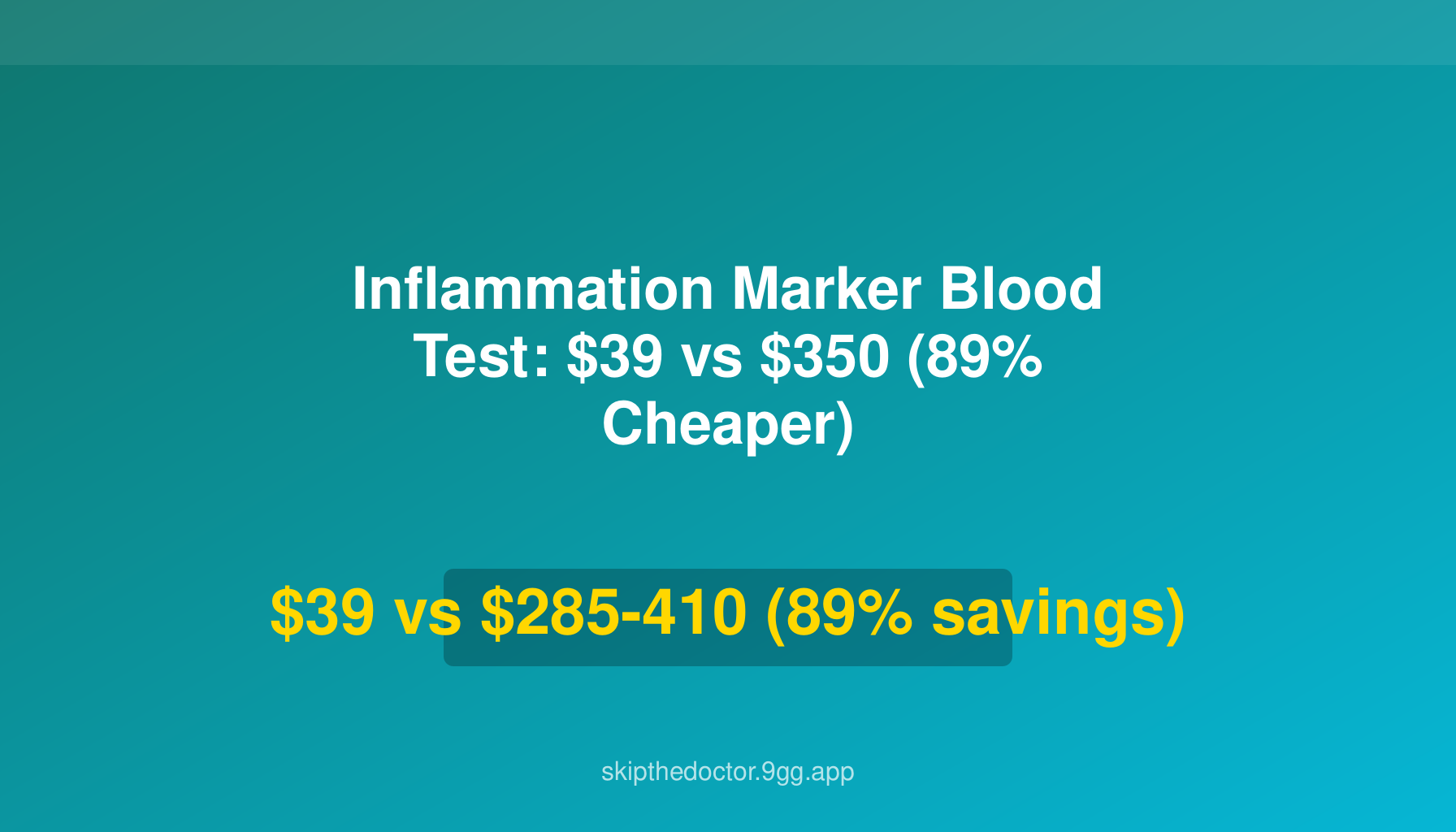
Inflammation Marker Blood Test: $39 vs $350 (89% Cheaper)
▶ Watch the full breakdown
I walk through the exact lab markers to check, what each test really costs, and how to order it yourself — no doctor visit needed. Press play.
Prefer YouTube? Watch & subscribe on the Skip The Doctor channel.
A standard inflammation marker blood test — the hs-CRP, ESR, and ferritin combo that primary care offices quietly order more than almost any other add-on panel in 2026 — runs about $39 direct-to-consumer at the same reference labs (Quest and LabCorp) that hospital systems bill $285 to $410 for. Get this test at HealthLabs (skip the $200-300 doctor markup) and the sample runs on the same analyzer, produces the same PDF, and lands in your patient portal in one to three business days — no office visit required.
The reason the markup exists is not the test. It is the office visit, the specimen handling fee, the facility fee, and the line item labeled ‘professional interpretation.’ According to the Cleveland Clinic, a C-reactive protein reading is a single reagent reaction that costs the lab under $10 to run. Everything else on the bill is billing infrastructure. If you are uninsured, on a high-deductible plan, or trying to track a chronic marker every 90 days, paying $350 for a $10 test is the kind of quiet leak that turns into real money over a year.
What an inflammation marker blood test actually measures
‘Inflammation’ is a category, not a single number. According to Mayo Clinic, the panels labeled inflammation marker blood test typically bundle two to four of the following:
- hs-CRP (high-sensitivity C-reactive protein) — a liver-produced protein that rises within hours of an inflammatory event. The high-sensitivity variant reads down to 0.1 mg/L, which is what makes it useful for tracking chronic low-grade inflammation as opposed to a raging infection.
- ESR (erythrocyte sedimentation rate) — measures how fast red blood cells settle in a tube over one hour. Slower and cheaper than CRP; still useful for autoimmune tracking per the NIH.
- Ferritin — an iron-storage protein that doubles as an acute-phase reactant. High ferritin alongside normal serum iron is a classic inflammation signal.
- Fibrinogen — a clotting factor that also spikes during inflammation. Less commonly ordered direct-to-consumer, but available on premium panels.
According to MedlinePlus, none of these markers is diagnostic on its own. They tell you whether something inflammatory is happening in your body, not what is causing it. A trending pattern — three data points over six months — is worth ten times more than a single reading, which is exactly the case for owning the test cadence rather than waiting for a doctor’s office to reorder it. Bring the pattern to a clinician; that is what turns numbers into useful conversation.
The real price breakdown: $39 direct vs $350 through a clinic
Here is what the same hs-CRP + ESR + ferritin panel looks like across the four channels an adult in the U.S. can actually use in 2026:
| Channel | Typical out-of-pocket | Lab used |
| Primary care visit + lab bill (uninsured) | $285 - $410 | Quest or LabCorp |
| Primary care visit + lab bill (HDHP, deductible not met) | $180 - $320 | Quest or LabCorp |
| Urgent care + panel add-on | $220 - $340 | Quest or LabCorp |
| Direct-to-consumer (HealthLabs, Personalabs, Ulta Lab Tests) | $39 - $79 | Quest or LabCorp |
The three DTC vendors in the bottom row all resell the same reference-lab capacity — they are essentially bulk wholesale buyers passing the price break to you. Per CMS Medicare fee schedule data, the reimbursement rate for hs-CRP (CPT 86141) is roughly $13.50; ESR (CPT 85652) is roughly $3.20; ferritin (CPT 82728) is roughly $16.10. Add a draw fee and you are at about $40 wholesale — which is why the DTC price of $39 to $79 makes sense and the clinic price of $285 does not.
If you are trying to keep up with routine bloodwork while between jobs or without coverage, the difference compounds fast. Our sister site has a longer breakdown of the tactics in Between Jobs and Uninsured? 7 Smart Ways to Keep Up With Bloodwork Without Going Broke — worth five minutes if a $300 bill is what has kept you from testing at all this year.
The counter-intuitive finding: hs-CRP predicts heart attacks better than LDL for one-third of adults
Here is the thing most people never hear from a general-practice visit. According to the Cleveland Clinic and Harvard’s widely cited JUPITER trial (as indexed on the NIH’s PubMed database), roughly one in three adults who have a heart attack have normal LDL cholesterol. What they often do have — and what a lipid panel misses — is elevated hs-CRP.
The Cleveland Clinic categorizes hs-CRP cardiovascular risk bands as: under 1.0 mg/L is low risk, 1.0 to 3.0 mg/L is average risk, and above 3.0 mg/L is high risk. That top band is associated with roughly a 2x heart attack risk multiplier over baseline, independent of your cholesterol number. For someone who has been told ‘your cholesterol looks fine’ for a decade, this is the reading that could have flagged a hidden risk — and it is the same $39 panel most people never order because they assume the annual physical covered it. It usually does not; hs-CRP is not part of a standard lipid panel or CBC.
None of this is a diagnosis or a treatment recommendation. It is a case for adding one line to your next lab order — and a conversation worth bringing to a clinician with actual data in hand, rather than triggering another billing event just to get the panel run.
How to order the panel without a doctor’s office (and when you should not)
The mechanical steps take about four minutes:
- Pick an inflammation panel from a DTC lab site. The direct-order inflammation panel on HealthLabs runs roughly $39 to $79 depending on whether you add ferritin and fibrinogen — versus the $285 to $410 the same tubes cost through a clinic visit.
- Pay online. A physician-network review is included at no extra charge; the network authorizes the requisition without an office visit.
- Walk into any Quest or LabCorp patient service center within the requisition window (usually 30 days). Most locations no longer require an appointment for standard draws.
- Fast only if the panel requires it — basic inflammation markers do not need fasting; if you add a lipid panel, then 9 to 12 hours.
- Results appear in your account portal in one to three business days, PDF-exportable to send to any clinician.
When you should not route through DTC:
- If you have symptoms of acute infection (high fever, severe pain, shortness of breath), the NIH advises urgent care or an emergency department — a mail-order requisition is not the right tool when hours matter.
- If you are pregnant, immunocompromised, or on immunosuppressive therapy, testing outside your care team’s protocol can create a data-versus-clinical-context gap that is not worth the $250 saved.
- If you live in New York, DTC lab regulations are stricter and most vendors will not ship requisitions there — check the vendor’s state list before paying.
Reading your results without spiraling: what the numbers actually mean
According to Mayo Clinic and MedlinePlus, the general adult reference ranges (which your lab report will also print) are:
- hs-CRP: under 1.0 mg/L (low CV risk), 1.0 to 3.0 (average), above 3.0 (elevated).
- Standard CRP: under 10 mg/L is normal; above 10 suggests active inflammation or infection.
- ESR: 0 to 22 mm/hr for men, 0 to 29 mm/hr for women (Mayo Clinic ranges; the NIH publishes slightly different age-adjusted bands).
- Ferritin: 24 to 336 ng/mL for men, 11 to 307 ng/mL for women (LabCorp reference range).
Two rules keep people out of trouble here:
One data point is not a trend. hs-CRP can spike 10 to 100 times over baseline after a hard workout, a bad cold, a dental cleaning, or 48 hours of poor sleep. A single elevated reading, per Cleveland Clinic guidance, is best repeated two to four weeks later before drawing any conclusions. Two data points a month apart cost you about $78 direct-to-consumer versus roughly $560 through a clinic — and the trend is what a thoughtful clinician actually wants to see.
Normal does not mean nothing is wrong. These markers detect general inflammation, not specific diseases. A normal panel is reassuring but not a clean bill of health, and an elevated panel is a signal to investigate, not a diagnosis. Bring the PDF to a clinician either way.
How often is worth the money
For most healthy adults who just want a baseline, once every 6 to 12 months is enough — about $40 to $80 a year. If you have a known autoimmune condition, are tracking a lifestyle intervention (weight change, dietary shift, new fitness program), or are watching a marker your doctor already flagged, quarterly is a common cadence — roughly $160 to $320 a year direct-to-consumer, versus $1,100 to $1,600 a year running the same schedule through a doctor’s office.
That is the number worth writing down: the difference between the DTC cadence and the clinic cadence is roughly $1,000 to $1,300 per person per year for anyone actively tracking. For a household of two adults on quarterly baselines, that is a $2,000+/year swing that goes into your pocket instead of a hospital’s revenue cycle — and it is the single most under-used cost-control move in preventive care right now. According to the CDC, fewer than 10% of U.S. adults are aware that most routine bloodwork can be self-ordered; the other 90% pay the office markup by default, mostly because nobody told them the direct channel exists.
Bottom line: order the panel, bring the PDF, keep the $250
An inflammation marker blood test is not exotic, not experimental, and not something you need a referral for. It is a $39 lab draw that most Americans overpay for by 8 to 10 times because the direct channel is quietly invisible. Order the panel, walk into a Quest or LabCorp patient service center on your schedule, and bring the PDF to whichever clinician you already trust — that is the pattern that keeps you informed AND keeps the $250 markup in your bank account instead of the hospital’s.
Ready to check your baseline? Order an inflammation marker blood test through HealthLabs — same reference labs as your doctor’s office, same PDF, roughly $39 to $79 instead of $285 to $410. Results in one to three business days. Bring the numbers to your next visit instead of paying the clinic to generate them for you.
Affiliate disclosure: this post may contain affiliate links; we earn a commission at no extra cost to you.
Order Your Own Lab Tests — No Doctor Required
HealthLabs lets you book bloodwork online, pay up to 80% less than a clinic, and use your FSA/HSA. Results in 24–48 hrs.
Order at HealthLabs → Save 60–80%Sources & references
This guide summarizes information from recognized medical authorities. Verify any health decision with these primary sources and your own clinician:
Ready to skip the markup?
Order your bloodwork online through HealthLabs. FSA/HSA accepted. Same certified labs, up to 80% less.
Order Lab Tests at HealthLabs →Get the next guide free
Plain-English lab-testing guides and price breakdowns, straight to your inbox. No spam.